Something is falling from the sky, and it’s not rain
Blog post from Marcos Eduardo Pérez Morán
Most of the time, when we look up, we are trying to know how the weather will be. If it will rain, if the sun will come out, or how we should plan our day. Yet, there is something we rarely stop to consider: what reaches the ground when the sky is clear. Even in the absence of clouds or precipitation, the atmosphere is constantly delivering particles to the surface in a silent and invisible process known as dry deposition. Without drops, without storms, and without being noticed, tiny aerosol particles travel across continents and oceans before finally settling on the ground, shaping the air we breathe and the environments we live in.
This is exactly the phenomenon I study in my PhD. During these first months as part of the DUST Doctoral Network, I’ve been trying to wrap my head around two main questions: where do the aerosol particles actually come from, and what can their properties tell us about their origin? What reaches the ground is not just the end of a long journey across deserts, oceans, and continents, but also a trace of the places the air has passed through. To explore this, I’ve been working with samples collected in the central Mediterranean, a region where air masses from North Africa, Europe, and the Atlantic often meet. In a way, it feels like placing a sensor in the middle of a busy highway and trying to figure out who is passing by, where they come from, and what they are carrying with them.
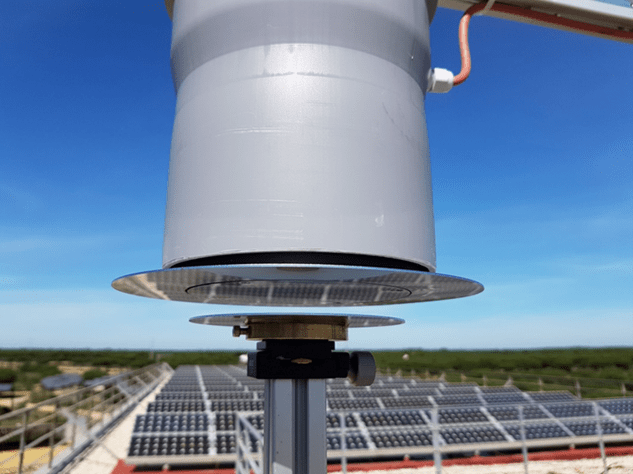
To actually capture these particles, we use automated passive samplers (Fig. 1) that sit on rooftops for days at a time, quietly collecting whatever settles from the air. They work a bit like passive traps for particles, but with one important detail: they are designed to avoid rain. As soon as the first drops are detected, a sensor automatically closes the system, so what we collect is only what falls under clear-sky conditions.
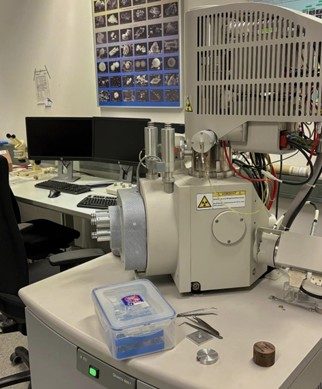
Once the sampling period is over, we retrieve the samples, and what looks like a clean surface to the naked eye reveals something completely different when observed under an electron microscope: thousands of tiny particles that have travelled long distances before finally reaching the ground. Looking at the samples under the electron microscope (Fig. 2) allows us to go much further than just seeing the particles; it lets us understand the properties of each one individually: its size, its shape, and what it is made of. In other words, we can read the “fingerprint” of every single particle.
This detailed microscopic characterization allows us to classify the particles into groups. We find that, although the samples contain a wide variety of types, they are predominantly dominated by two main categories: mineral dust and sea salt. This simple distinction already gives us a first clue about the environments the air masses have interacted with during their journey. But even with all this information, one important piece of the story is still missing: where exactly did these particles come from?
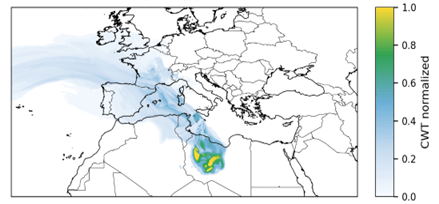
To answer that, we use a model called FLEXPART, which can be used as a tracker of air masses. Using meteorological data, it allows us to trace the path of the air backwards in time and identify the regions it passed through before reaching our collectors. This way, we can connect what we observe under the microscope with the places those particles are likely coming from. To strengthen this analysis, FLEXPART is complemented with statistical techniques such as Concentration Weighted Trajectory (CWT), which help highlight the regions that are more strongly associated with the observed deposition.
We applied this approach to all the collected samples, but to illustrate how it works, we can look at one specific case: the sample with the highest mineral dust deposition at San Lawrenz, Malta (Fig. 3). This example shows how strongly this location is influenced by dust sources from the northern Sahara, specifically the Libyan Desert, giving us a clear picture of the particle types we can typically expect from this region.
Understanding where this material comes from, and what its properties tell us, is not just a scientific curiosity. It helps us better understand the air we breathe, the processes that shape our climate, and how different regions of the world are connected through the atmosphere. These particles can carry nutrients to marine ecosystems, influence how sunlight interacts with the Earth, and transport pollutants across long distances. By linking what we observe on the ground with what happens in the atmosphere, we can improve the way we model these processes and better anticipate their impacts on both the environment and human health. In the end, what may seem like invisible dust falling from the sky is actually part of a much larger story, one that connects deserts, oceans, cities, and the air around us in ways we are only beginning to understand.